Your lateral or the city main?
Every Visalia home on city sewer has a private lateral — the pipe from the house to the public main under the street — and the main itself, which belongs to the city. Sanitary Collections, under the Public Works Department's Wastewater Division, maintains the city's sewer mains. A backup that is in the city main rather than your lateral is theirs to clear.
| What you see | Likely location | Who to call |
|---|---|---|
| Only your house is affected; lowest drain backs up when you run water | Your private lateral (or a branch line) | A licensed plumber |
| Neighbors have the same problem at the same time | Public main | City of Visalia Sanitary Collections, 559-713-4403 (after hours: 559-734-8116) |
| Wastewater surfacing from a manhole, curb, or the street | Public main | City of Visalia, same numbers |
| Wastewater surfacing in your yard between the house and street | Your lateral — broken or collapsed | A licensed plumber; expect a camera and a repair quote |
| Backup started right after heavy rain | Could be either — a surcharged main, or groundwater entering a cracked lateral | Call the city first (free), then a plumber if the city clears its side |
One thing this site will not tell you, because the city does not publish it: exactly where your responsibility for the lateral ends — at the property line, the curb, or the main. Some California cities own the portion under the street; some do not. When a plumber locates a blockage close to the street, ask where it sits relative to the property line, and ask Sanitary Collections the same question before authorizing a dig in the parkway.
Why sewer lines back up in Visalia
Tree roots. A USDA Forest Service review of sewer root intrusion found roots are reported to cause more than half of all sewer blockages, and that annual or every-other-year root removal is common in smaller pipes. source Visalia's established neighborhoods have exactly the combination that produces it: mature street and yard trees, and original clay or cast-iron laterals with a joint every few feet for roots to find. A main line that re-clogs every year or two is almost always roots.
Grease and solids. Kitchen grease that made it past the branch line ends up coating the lateral, and "flushable" wipes catch on any rough spot. This is the failure mode hydro jetting fixes and cabling only postpones.
Bellies and offset joints. A belly is a sag in the line where the soil settled beneath it; water pools there, solids drop out, and the line clogs at the same spot repeatedly. Mapped soils around Visalia are alluvial sandy loams and loamy sands (Nord, Hanford, Tujunga series) and San Joaquin loam, a hardpan series — not the expansive clay some sewer-repair marketing assumes. Sandy, loose alluvial soil settles more easily under a poorly bedded pipe than clay does, which is one reason bellies show up in the camera footage of otherwise sound lines here. An offset joint is two sections of pipe no longer aligned — a step that catches everything.
Collapsed or crushed pipe. Old clay cracks; cast iron rusts through from the bottom; Orangeburg (a tar-impregnated fiber pipe used mid-century) simply deforms and fails. A collapse is the case where cabling will not help and a repair is the only fix.
Clearing the line: cabling, jetting, and the camera
The first visit is about getting water flowing. The second decision — whether anything needs repair — should come from a camera, not from a guess.
| Job | Typical range | Sourcing |
|---|---|---|
| Main sewer line cabling (via cleanout) | $175–$500 | National |
| Main line cabling, no cleanout (toilet pull or roof vent) | $300–$600 | National |
| Hydro jetting (residential main line) | $350–$900 | National |
| Sewer camera inspection (standalone) | $150–$500 | National |
| Install a two-way sewer cleanout | $1,400–$3,500 | NationalCalifornia |
How these ranges were built (verified 2026-09-13): Ranges are compiled from dated national cost guides (HomeGuide, Angi), cross-checked against California-specific plumber-published guides where one exists, and against the only Central Valley plumber we found publishing a hard price. No Visalia plumbing company publishes prices, so every row is labelled with how local its sourcing actually is. Figures are what a homeowner typically pays; your quote depends on access, pipe condition, and timing.
Sources for this table
- HomeGuide — National, 2025-12-01
- Angi — National, 2026-07-08
- Angi — National, 2026-07-09
- HomeGuide — National, 2025-07-14
- HomeGuide — National, 2025-12-19
- Angi — National, 2026-07-09
- Angi — National, 2026-07-09
- HomeGuide — National, 2025-08-28
- Alpine Plumbing (San Dimas, CA) — 2026 slab leak / leak detection guide — California, 2026-06-19
Cabling cuts a hole through the blockage with a rotating steel cable and is the right first move for a first-time backup. Hydro jetting scours the pipe wall with high-pressure water and is the right move for grease, sludge, and recurring roots — but it should follow a camera, not precede one, because jetting a badly deteriorated pipe can finish it off. The camera inspection is the part to insist on: it shows pipe material, the location and depth of the problem, and whether it is a clog, a root mass, a belly, or a break. Ask to watch the monitor, and ask for a copy of the footage. A company that will not show you the video is asking you to take a repair quote on faith.
If the house has no exterior cleanout — common in older Visalia homes — the plumber has to pull a toilet or go in through the roof vent, which is the difference between the $175–$500 and $300–$600 rows. After a second main-line call, a two-way cleanout ($1,400–$3,500) is worth the money: it makes every future clearing cheaper and gives the camera a straight shot at the lateral.
Repair: spot repair, full replacement, or trenchless
If the camera shows a break, offset, belly, or collapse, cabling is a stopgap and the conversation turns to repair. There are three honest options, and the right one depends on what is above the pipe as much as what is wrong with it.
| Job | Typical range | Sourcing |
|---|---|---|
| Sewer line spot repair (one section, dig) | $600–$3,500 | National |
| Full sewer line replacement, traditional dig | $50–$200/linear ft $3,000–$10,000 for a typical Visalia lot | NationalCalifornia |
| Full sewer line replacement, traditional dig (whole job) | $3,000–$10,000 | NationalCalifornia |
| Trenchless repair (pipe lining or pipe bursting) | $80–$250/linear ft $4,000–$12,000 for a typical whole-house run | CaliforniaNational |
| Trenchless repair, whole-house run | $4,000–$12,000 | CaliforniaNational |
How these ranges were built (verified 2026-09-13): Ranges are compiled from dated national cost guides (HomeGuide, Angi), cross-checked against California-specific plumber-published guides where one exists, and against the only Central Valley plumber we found publishing a hard price. No Visalia plumbing company publishes prices, so every row is labelled with how local its sourcing actually is. Figures are what a homeowner typically pays; your quote depends on access, pipe condition, and timing.
Sources for this table
- Angi — National, 2026-08-03
- HomeGuide — National, 2025-12-22
- Express Sewer & Drain (Rancho Cordova, CA) — trenchless cost guide — California, 2024-08-23
- Angi — National, 2026-07-10
Trenchless vs. dig: a decision framework
No local company publishes this comparison, so here it is.
| Factor | Favors traditional dig | Favors trenchless (lining or bursting) |
|---|---|---|
| What's above the pipe | Open lawn or dirt, short run to the main | Driveway, patio, pool deck, mature trees, mature landscaping, the public street |
| Pipe condition on camera | Collapsed, crushed, missing sections, severe belly | Cracked, root-invaded, offset joints, but continuous end to end |
| Length of run | Short (under ~30 ft) | Long runs, where the per-foot savings on restoration add up |
| Bellies (sags) | Dig is the only real fix — the pipe has to be re-bedded at grade | Lining follows the sag; it does not remove it |
| Pipe diameter | No change | Lining reduces the inside diameter slightly; bursting keeps or upsizes it |
| Restoration cost | Add concrete, landscaping, and possibly street-cut permits on top of the pipe price | Two small access pits, usually at the cleanout and the property line |
| Typical price | $50–$200/linear ft, $3,000–$10,000 total | $80–$250/linear ft, $4,000–$12,000 total |
| Time | 1–3 days plus restoration | Often one day |
Pipe lining (CIPP) inserts a resin-saturated liner into the existing pipe and cures it in place, creating a new jointless pipe inside the old one — roots have no joint to find. Pipe bursting pulls a new HDPE pipe through the old one while a bursting head shatters the original outward; it is the trenchless choice when the old pipe is too damaged to line or you want a larger diameter. Both need a mostly continuous existing pipe. A collapse, a missing section, or a serious belly sends you back to the shovel.
A fair quote for either should include: the camera footage it is based on, the length of run being repaired, the access points, the permit, and what restoration is and is not included. Get a second quote on anything over the spot-repair range — a second camera is cheap next to a five-figure job.
Permits, licensing, and insurance
Visalia Municipal Code §13.08.810 sets a city inspection fee for "the system from the end of the building drain to a public sewer" — the building sewer (lateral) is permitted and inspected work in Visalia. That permit is pulled by the contractor and should appear on the quote; a company that suggests skipping it is asking you to accept unpermitted, uninspected work on the one pipe in your house you least want to dig up twice. The Building Division is at 707 W. Acequia Ave., Visalia, CA 93291, 559-713-4300.
Because the work needs a permit, it is licensed work regardless of the price: Since January 1, 2025, California allows unlicensed work only when the whole job (labor and materials) is $1,000 or less, no building permit is required, and the person doing it employs nobody else on the job. If any one of those fails, a licensed contractor is required regardless of price. Plumbing work in California is licensed by the Contractors State License Board under the C-36 Plumbing Contractor classification, which covers water supply, drain and waste piping, gas piping, water heaters, and the maintenance of those systems. The how-we-match page shows the license lookup step by step.
On insurance: The Insurance Information Institute notes that sewer backups are not covered under a typical homeowners policy or by flood insurance, and that sewer-backup coverage is sold separately as an endorsement by most insurers. source Look for a "water backup" or "sewer backup" line on your declarations page. If it is there, the cleanup and damaged contents are usually covered; the pipe repair itself often is not, regardless of endorsement, because insurers treat it as maintenance.
After the line is clear
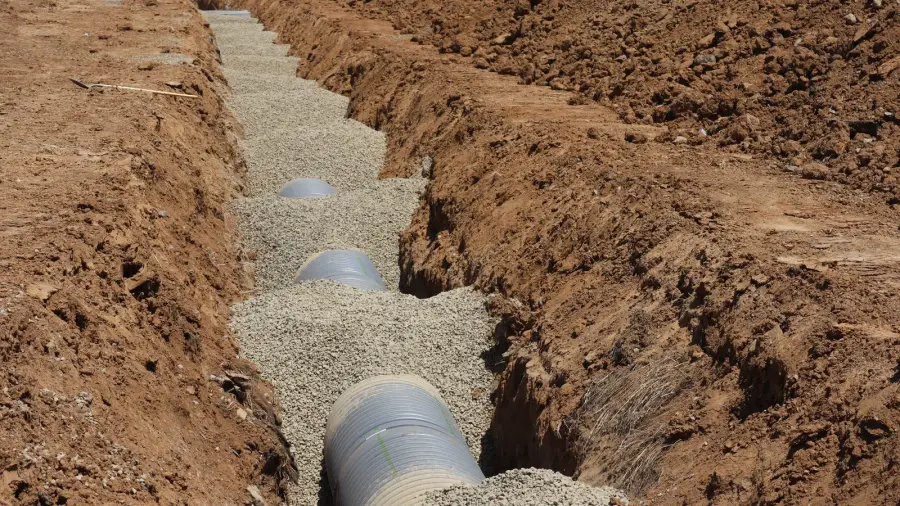
Category 3 water — sewage — requires more than mopping. Porous materials that absorbed it (carpet and pad, drywall below the water line, particleboard cabinets) are usually removed rather than dried. Hard surfaces get cleaned and disinfected. For anything beyond a small bathroom floor, a water-damage restoration company is a separate call from the plumber, and it is the part of the bill that sewer-backup insurance coverage is for. Keep the plumber's invoice and the camera footage; both go into the claim.
Outside Visalia city limits
Visalia is the Tulare County seat. Tulare, Exeter, and Porterville are also in Tulare County; Hanford is the seat of neighboring Kings County. Sewer mains in Tulare, Exeter, Porterville, and Hanford belong to those cities, so the "is it the main?" call goes to the local public works department, not Visalia's. The plumber side is the same: most Visalia companies that do sewer work cover all five, and requests submitted here are routed by the ZIP code you enter.