Every drain in a house connects to the same sewer, and the only thing standing between your kitchen and the gas in that sewer is a few inches of water sitting in a U-shaped bend under each fixture. When the smell shows up, something has either emptied one of those water seals, opened a gap the seal cannot cover, or blocked the vent that is supposed to carry the gas up through the roof instead. Work the list top to bottom; most people stop at number one or two.
1. A dry P-trap (free)
The U-bend under every sink, tub, shower, floor drain, and laundry standpipe holds water. That water is the seal. Leave a drain unused for two to four weeks in a Visalia summer — a guest bathroom, the utility-room floor drain, the second shower nobody uses — and it evaporates. The sewer is then open into the room. Fix: pour a quart of water down every drain in the house you cannot remember using, and wait a day. For drains you know will sit idle, a tablespoon of mineral oil on top of the water slows evaporation for months. This is the cause in a large share of sewer-smell calls, and it is embarrassing to pay a service call to find it.
A trap that keeps going dry in a drain you do use is a different problem: siphoning. When a nearby fixture drains hard, it can pull the water out of a trap that is not properly vented — common on older S-traps under sinks and on remodels where a vent was never added. The smell returns every time the other fixture is used. That one is a plumber's fix (adding an air admittance valve or a proper vent).
2. A failed toilet wax ring
The toilet does not have a trap under the floor; its trap is built into the bowl. What seals the toilet to the drain flange in the floor is a ring of wax, and it fails when the toilet rocks, when the flange sits too low after a floor was tiled over, or simply after twenty years. The tells: smell strongest at floor level around the toilet, a toilet that rocks even slightly, water or staining at the base after flushing, or a vinyl floor that has gone soft next to it. Fix: pull the toilet, replace the ring (or use a flange extender if the flange is low), reset and shim so it cannot rock. Handy owners do this; a plumber does it in an hour or so at $75–$150/hr plus the service call, and it is worth having the flange looked at while the toilet is off.
3. A blocked or disconnected vent
Every drain system vents through one or more pipes that exit the roof. The vent lets air in behind draining water (so traps do not siphon) and lets sewer gas out above the house. Block the vent — a bird's nest, leaves, a tennis ball, ice in a rare hard freeze — and drains gurgle, traps siphon, and gas finds the next easiest exit, which is your bathroom. A vent that was disconnected inside a wall or attic during a remodel does the same thing, except the gas exits into the attic and drifts down. Tells: gurgling from a drain when another fixture is used; smell that is worse when the house is closed up; smell in a room with no plumbing in it (attic-adjacent). Fix: from the roof, a hose down the vent stack clears leaves; a plumber's cable clears a nest. A disconnected vent needs finding — this is where a smoke test earns its keep.
4. A loose or missing cleanout cap
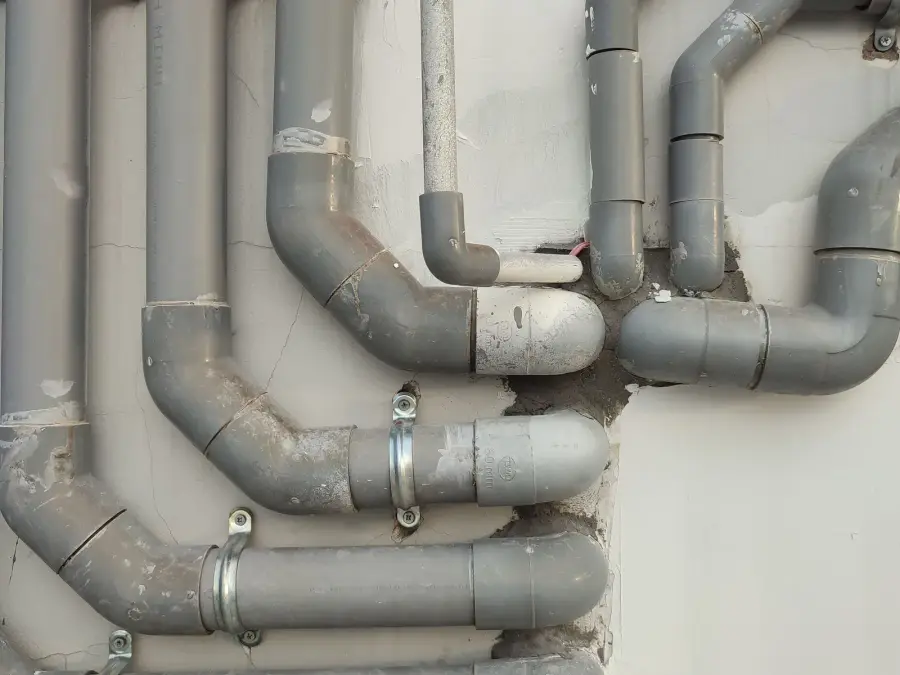
The drain line has capped access points — cleanouts — inside the house (often in a garage or utility wall) and outside where the line leaves the foundation. A cap that was left loose after a drain cleaning, cracked, or never replaced is a direct opening to the sewer. Tells: smell in the garage, laundry, or crawlspace rather than a bathroom; a visible capped pipe nearby. Fix: tighten it or buy a new threaded cap for a few dollars. Check this before paying anyone.
5. Buildup in the drain itself
A shower or bathroom-sink drain that smells musty-sour rather than like sewage is usually biofilm — the slime of hair, soap, and skin that lines the first foot of pipe and the trap. A kitchen drain that smells rancid is grease. Neither is sewer gas, but both get reported as "sewer smell." Fix: a stiff brush and hot water for a shower drain, an enzyme cleaner left overnight, and for a kitchen line a $99–$250 cabling if the smell comes with slow drainage. Skip the caustic chemical cleaners — they sit in a slow line and damage the pipe and the next plumber's hands.
6. A partial blockage in the main line
When the main line under the house or yard is partly blocked — by roots, most often — waste sits in the pipe instead of leaving, and the gas it produces has time to back up through the weakest seal in the house. Tells: the smell comes with gurgling at the lowest drain when an upstairs fixture is used, with slow drains in more than one room, or with a toilet whose water level rises and falls on its own. A USDA Forest Service review of sewer root intrusion found roots are reported to cause more than half of all sewer blockages, and that annual or every-other-year root removal is common in smaller pipes. source Fix: this is the sewer backup page's territory — a $175–$500 cabling through the cleanout, and a $150–$500 camera look at what is actually in the line before anyone quotes a repair.
7. A cracked, separated, or collapsed drain line
Least common, most expensive, and the one people fear first. A line that has separated at a joint under the slab or in the yard leaks wastewater into the soil, and the gas comes up through the slab, a crawlspace, or the ground next to the foundation. Tells: smell strongest at the floor or outside along one wall; a persistently damp patch of yard or an unusually green strip of lawn in a Visalia summer; foundation-adjacent soil that smells; sometimes cockroaches or drain flies arriving from nowhere. Around Visalia, the mechanism is usually settling: Mapped soils around Visalia are alluvial sandy loams and loamy sands (Nord, Hanford, Tujunga series) and San Joaquin loam, a hardpan series — not the expansive clay some sewer-repair marketing assumes. A pipe laid without proper bedding in that loose alluvial soil sags into a belly or pulls a joint apart over decades. Fix: a camera inspection to locate it, then a spot repair or a section replacement — costs and the trenchless-versus-dig decision are on the sewer page.
What the plumber's part costs in Visalia
| Job | Typical range | Sourcing |
|---|---|---|
| Service call / diagnostic fee | $50–$150 | NationalCalifornia |
| Plumber hourly rate (standard hours) | $75–$150/hr | CaliforniaNational |
| Sewer camera inspection (standalone) | $150–$500 | National |
| Main sewer line cabling (via cleanout) | $175–$500 | National |
| Sewer line spot repair (one section, dig) | $600–$3,500 | National |
How these ranges were built (verified 2026-09-13): Ranges are compiled from dated national cost guides (HomeGuide, Angi), cross-checked against California-specific plumber-published guides where one exists, and against the only Central Valley plumber we found publishing a hard price. No Visalia plumbing company publishes prices, so every row is labelled with how local its sourcing actually is. Figures are what a homeowner typically pays; your quote depends on access, pipe condition, and timing.
Sources for this table
- HomeGuide — National, 2023-09-25
- Mike Diamond Services (Los Angeles) — CA plumber hourly-rate guide — California, 2025-08-31
- HomeGuide — National, 2025-12-19
- Angi — National, 2026-07-09
- HomeGuide — National, 2025-12-01
- Angi — National, 2026-07-08
- Angi — National, 2026-08-03
- HomeGuide — National, 2025-12-22
The point of the ordering above is that causes one, four, and five cost nothing or nearly nothing, and cause two is an hour's labor. Only six and seven need the camera, and only seven needs a repair. A plumber who arrives at a sewer-smell call and quotes a main-line repair before running water in the guest bath and checking the cleanout caps has skipped the list — and you now have the list.
The definitive test: smoke
When the free checks come up empty and the smell persists, the tool that ends the guessing is a smoke test. The plumber plugs the main cleanout, pushes harmless, visible smoke into the drain system through a vent or cleanout with a low-pressure blower, and walks the house watching where it leaks out: a hairline crack in a trap, a slip joint behind a vanity, a vent disconnected in the attic, a wax ring. It takes an hour or two and it finds things a camera cannot see because they are on the air side, not the water side. If you have paid for two diagnostic visits without a finding, ask for this by name.
When it is the city's pipe
Sewer smell that is stronger outside — at the curb, near a manhole, along the street — and that neighbors also notice is usually the public main venting through manholes or a surcharged line, not anything under your house. Sanitary Collections, under the Public Works Department's Wastewater Division, maintains the city's sewer mains. A backup that is in the city main rather than your lateral is theirs to clear. In Visalia, that is Sanitary Collections at 559-713-4403 during business hours; the after-hours routing and every other catchment city's number are on the service area page. Call them before a plumber. A plumber cannot touch the main and will bill for saying so.
About the figures
Ranges are compiled from dated national cost guides (HomeGuide, Angi), cross-checked against California-specific plumber-published guides where one exists, and against the only Central Valley plumber we found publishing a hard price. No Visalia plumbing company publishes prices, so every row is labelled with how local its sourcing actually is. Figures are what a homeowner typically pays; your quote depends on access, pipe condition, and timing. Sources and dates are in the list beneath the table above; every range on this site comes from one dataset, rechecked every six months, so the numbers here match the cost guide exactly.